Thursday, June 25, 2015

FALSE JAPANESE BEETLE (Strigoderma arbicola) showing up in Iowa

NICK CHRISTIANS
JUNE 25, 2015
nchris@iastate.edu

Here is a post from Dr. Donald Lewis, entomologist at Iowa State University.  In recent weeks, we have both been contacted about Japanes beetles (Popillia japonica) showing up in central Iowa.  Don has found that these are actually False Japanese beetles (Strigoderma arbicola). We do get Japanese beetles here, although last year populations were low.


Here is Don's post.


From: Lewis, Donald R [ENT]
Pest identification is a keystone to IPM.  An example going on now is the emergence of False Japanese Beetles (FJB) in eastern and central Iowa.  As the name implies, false Japanese beetle (Strigoderma arbicola) is very similar in appearance to the true Japanese beetle.  The major difference is the coloration.  False Japanese beetles do not have the bright green and copper coloration of the Japanese beetle.  They are dark tan to brown though the thorax may appear metallic green on some specimens.  False Japanese beetles do not have the five white hair tufts that are prominent on each side of the abdomen of the Japanese beetle.   Here is a link to a close-up photo of FJB where these characteristics can be viewed. 

The BugGuide website uses the common name “sand chafer” which matches very well the locations where we must commonly see this beetle in fields, gardens and lawns.  However, the common name “false Japanese beetle” has been used in Iowa for at least the past 50 years!  The False Japanese Beetle is moderately common in the state but varies greatly from year to year.  Others are reporting more than usual this year.

Technical information about false Japanese beetle:  http://bugguide.net/node/view/44690

An old article about FJB:  http://www.ipm.iastate.edu/ipm/hortnews/1999/7-2-1999/fjapbeet.html  Note since 1999 the true Japanese beetle has expanded its range in Iowa to 63 counties (not the 5 listed in the chart).

Thanks.

Donald Lewis

Donald R. Lewis
Professor
Department of Entomology
Iowa State University
Ames IA 50011

Wednesday, June 17, 2015

WINDMILL GRASS REARS ITS UGLY HEAD.

Nick Christians
June 17, 2015
nchris@iastate.edu

 Here are a couple of pictures of Windmill grass (Choris verticillata) from Larry Ginger of American Lawn Care in Des Moines, Ia.  This warm-season grass is fairly new to Iowa, but I get more questions on it every year.  As it matures, it will form a large, open seedhead that looks a little like a windmill.  It spreads by stolons and by seed and increases every year in this area, particularly along city streets and on south facing slopes.  The seedhead will detach from the plant at maturity and roll over the turf like a tumble weed to spread its seed.  This is the main reason that it has spread so quickly. 


Roundup will kill it, but that will also kill the other lawn grasses.  Tenacity (mesotrione) is also labeled for it, but you will need to be persistent to completely remove it.

Search this blog for early articles on this species.

Here is a closeup of the seed head as it will appear in late summer.


Here is a comment from Doug Schryver of Sterling, IL o


Nick,

     I just wanted to comment on your post about Windmill Grass. One of my duties at the Park District in Sterling Illinois is Turf Management and I’ve read where the only herbicide that is recommended for Windmill Grass is Tenacity. I live in rural Whiteside County (northwest Illinois) and the soil in our neighborhood is very sandy and I’ve noticed a lot of Windmill Grass in the area. About three years ago most of our front yard was Windmill Grass and I decided to try to rid the yard of it. Each spring I usually would use a de-thatcher on the yard until I realized that it was actually just mixing the seed from the Windmill Grass into the soil and opening up the soil to the seed, so I no longer de-thatch. I used Tenacity on the yard in three sequential applications 7-10 days apart and had good luck controlling the weed. At that point our yard was very thin in that area so the rest of the season I would physically pull any Windmill Grass plants that I would see along with collecting any seed heads that would roll into the yard from a neighbor. That fall I overseeded the area with Barenbrug 50/50 RPR (Kentucky Blue/Regenerating Perennial Rye) at 7 #/m and I was able to establish a very thick carpet of turf. Now I mow at 3” height of cut, twice a week and I’m very diligent about pulling any kind of weed and collecting any seed heads when I see them and fertilizing on a regular schedule to keep a thick canopy of turf to prevent the Windmill Grass from gaining a foot hold. It was a lot of work for about a year but now I’m very happy with the result! Some of my neighbors have noticed and have asked how I got rid of that pesky weed.
                                Sincerely,
                                                Doug Schryver


Monday, June 15, 2015

CONSTRUCTION OF SPORTS TURF RESEARCH AREA AT IOWA STATE

Nick Christians
June 15, 2015.

Here is a blog from Dan Strey, research associate at the turf research site.  It is about the new construction that he is doing at the Hort Research Station.  This will be part of the turf field day on July 23, 2015.


ISU Expanding Sports Turf Research
June 15, 2015
Dan Strey

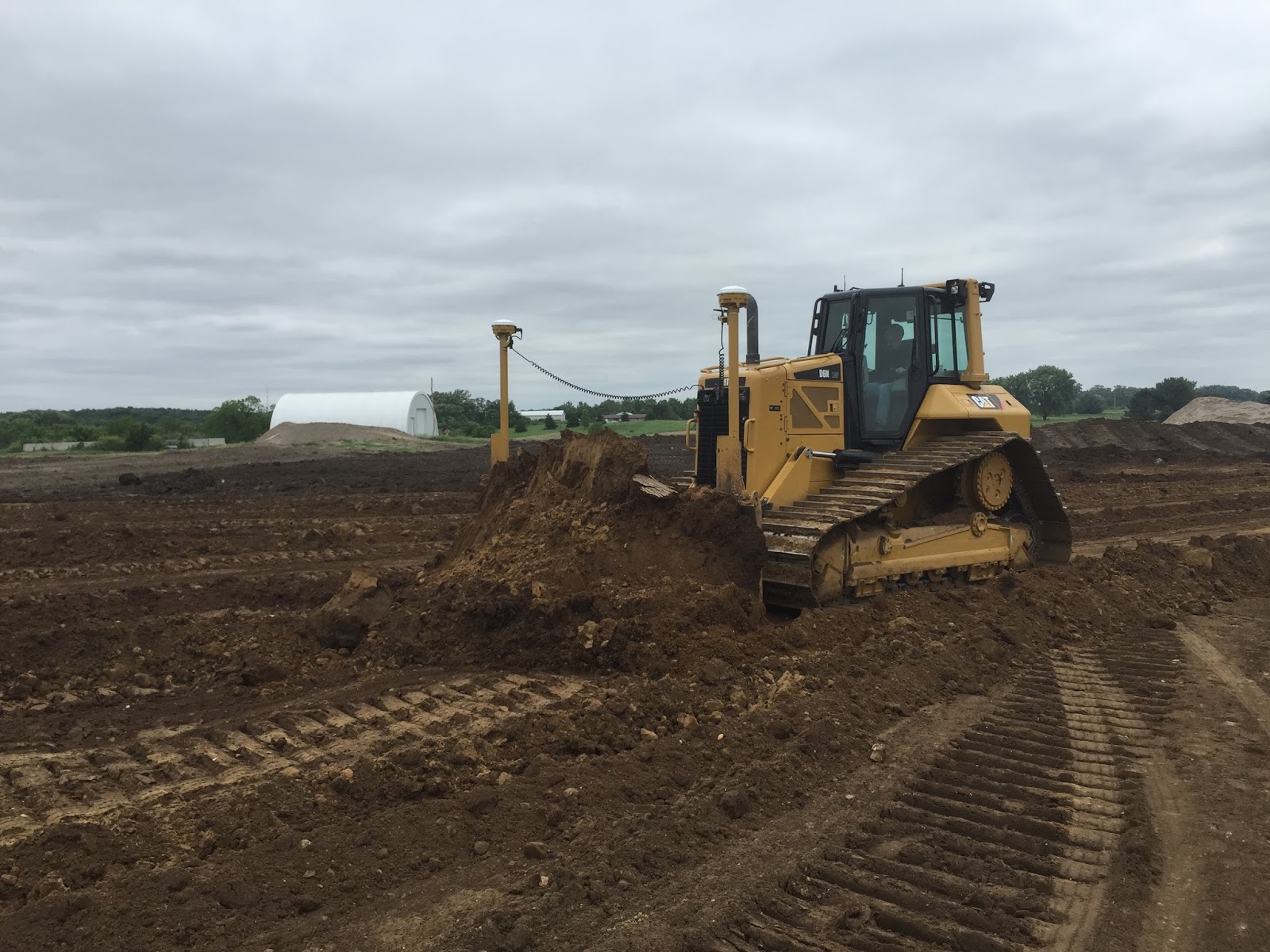
Just over a couple of weeks ago, we began construction of a new three acre site that will be used for future sports turf research. The area will be divided into three different plots. The first being a native soil field. Topsoil from the existing site was stripped and stockpiled prior to reshaping. Once the clay subgrade was moved and leveled, ten to twelve inches of topsoil was then placed on top. The second plot will evaluate sand topdressing over existing native soil fields. The construction process will be similar to that of the native soil field. Once the area is seeded, topdressing will begin to take place. Lastly, the third plot will have a four inch sand cap. The subgrade will contain a minimum of four inches below the sand cap. The three plots were designed to represent the major types of fields being used and constructed in the state of Iowa as well as the Midwest.

The rough grade is nearing completion. We spent the last two weeks moving over 6,000 cubic yards of soil. We expect to begin the irrigation work within the next week or two. The system includes 72 heads, 24 electric valves, 8 isolation valves, 12 quick couplers, 3 miles of wire and 1.25 miles of pipe. Once complete, we will move on to the drainage system.

Last week the Iowa State News Service published a press release regarding the construction project. They included a video from the site. The link to the release is http://www.news.iastate.edu/news/2015/06/10/sportsturf

 The Ames Tribune also ran a story on this last week, here is the link http://amestrib.com/news/new-isu-sports-turf-research-park-underway.


Planning for the project started last fall where we identified the location, plans were constructed, and  sought out donations to help fund the project. We had an overwhelming response from the turf, irrigation, and construction industries. By early spring, the project was 100% funded. Here is a list of our sponsors and donors.


Hunter Industries
Cresline Pipe
Nibco Valves
Regency Wire
John Deere Landscapes
Rainbird Irrigation
Ziegler Caterpillar
Trimble GPS
Iowa Turfgrass Institute
Iowa Sports Turf Managers Assoc.
United Seeds
Bush Sports Turf
Lasco Fittings, Inc.
Harco Fittings
MTI Distributing
ISU Department of Horticulture


Thank you to everyone who has helped make this project happen!

Dan Strey


 Here are some pictures from the construction process.  As of June 15, the subgrade has been completed and the top soil placed. 


Friday, May 15, 2015

Dollar Spot and Leaf Spot


Over the last week, dollar spot and leaf spot have popped up across the state of Iowa.

Dollar spot is usually considered an early to mid-summer disease and seems to be about a month ahead of last year. It is caused by the fungal organism Sclerotinia homoeocarpa. Most of the damage I have seen this spring has occurred on bentgrass greens, tees, and fairways. The symptoms of dollar spot on close mown turf (such as bentgrass) are small, tan-colored spot equal to or smaller than 2.5 inches across. The name of Dollar Spot comes from the silver dollar-sized turf damage. Spots can be numerous and coalesce, making identification difficult. Dollar spot is most notable on nitrogen deficient turf. By increasing fertility, you can reduce future outbreaks. Dollar spot can spread by movement of mowers, equipment, water, wind, and people. It has a very wide range of activity. It is most active in temperatures between 60-90 degrees but can occur as long as nights are over 50 degrees (which has been consistent over the last week).  The wet weather/ and high humidity have created an ideal situation for early season dollar spot. 

Removing the dew and guttation water early in the morning through mowing and dragging will help manage dollar spot. Active dollar spot infections produce a cottony white mycelium mass that is often evident on the turf during the early morning hours, not to be confused with spider webs. Fungicides (DMIs) do very well against dollar spot. Chlorothalonil, propiconazole, fenarimol and others are labeled for dollar spot control. It is important to remember that several site-specific inhibitors have the potential for fungicide resistance. To prevent resistance use a rotation of chemicals and avoid repetitive use.  

 Pictures courtesy of Cody Freeman - Green King Turf
 
Leaf spot is an Ascomycete fungi caused by Bipolaris spp. and/or Dreschslera spp. Cool, wet weather favors the disease. Leaf spot affects all turfgrass species used in the state of Iowa. A majority of the damage recorded so far has been on Kentucky bluegrass lawns and golf course roughs. It can also hit bentgrass, fine and tall fescue, and ryegrass.  

The ecology of leaf spot is prolonged wet periods (10+ hours) alternating with drying. The conditions this spring have been perfect for leaf spot on Kentucky bluegrass. Off-color patches of the turf are the first sign of the disease. The turf on the area may also look like it is dry, even after rainfall. A closer look at the leaf tissue shows elliptical purple spots turning to straw-colored on bluegrass.

Leaf spot is most commonly observed in high N fertility situations, and poor surface and subsurface drainage areas. There are several resistant Kentucky bluegrass cultivars in blends or mixtures and this is one of the main reasons it only affects certain areas of the turf.Fungicides are a last resort and generally not recommended on Kentucky bluegrass lawns or low maintenance areas of golf courses. If control is necessary, thiophanates, most QoI (Strobilurins), and chloronitriles provide the best means of control. 

 Pictures courtesy of Cody Freeman - Green King Turf