Friday, April 12, 2013

UPDATE ON SNOW COVER IN MOSCOW

Nick Christians
April 12, 2013


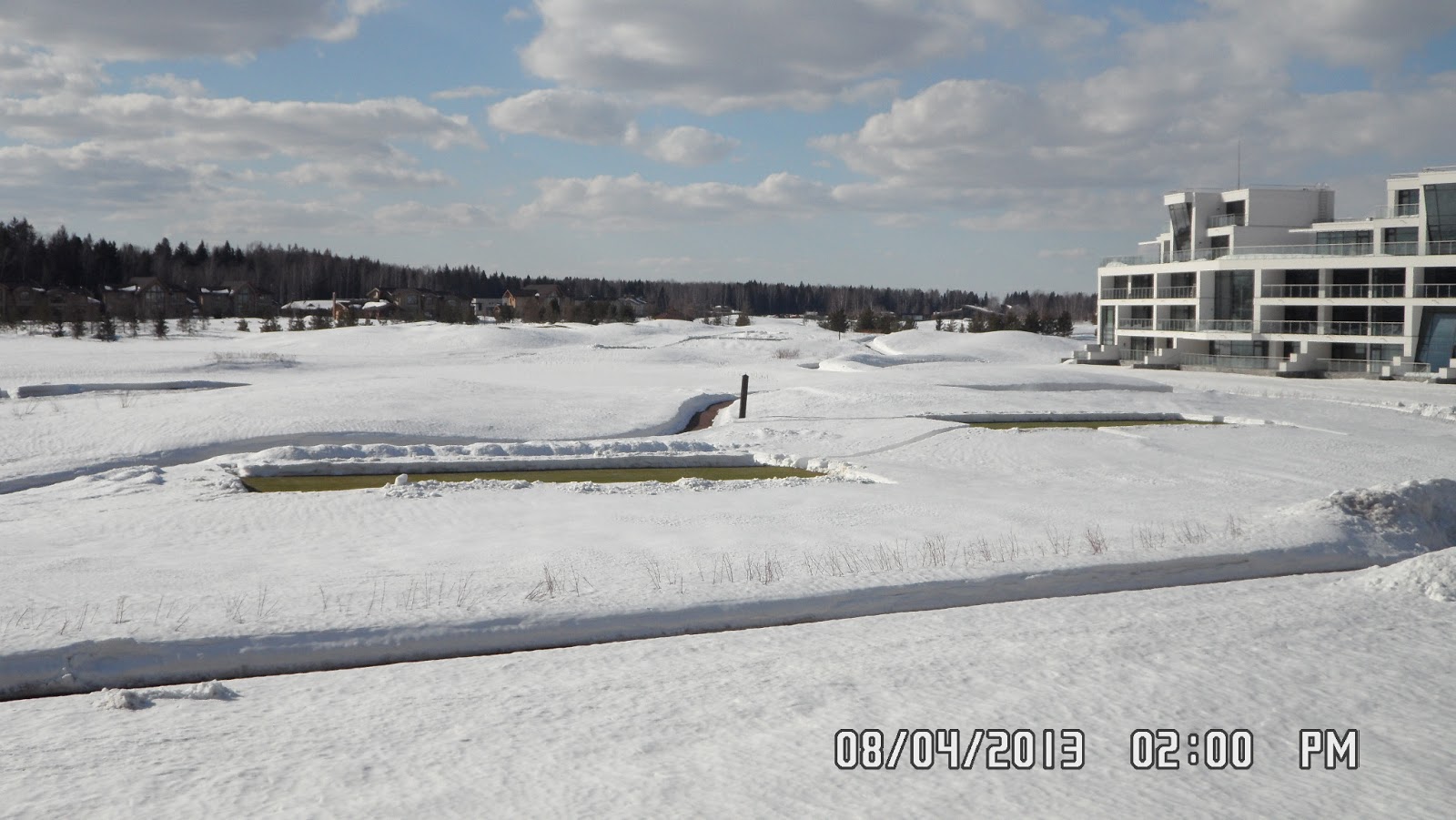
 Here is an update from Ken Siems of the Pestovo Golf and Yacht Club in Moscow.  The first picture is from April 8 and the second one is from April 12, 2013.  He has removed snow cover from some of the key areas on the golf course, but is expecting snow cover to last in May.  So far, the grass has been pretty healthy under the snow, with little snow mold  (he treated for snow mold before the first snow). 

This is one of the latest snow covers that I am familiar with.  It will be very interesting to see how the course emerges from the winter.  Ken will continue to keep us informed as the snow melts.


Wednesday, April 10, 2013

DROUGHT DAMAGE SHOWING UP THIS SPRING

Nick Christians
April 10, 2013

Here are some interesting pictures from Rob Elder of Omaha Organics showing the impact of the drought this spring on Omaha lawns.  Damage this bad is a problem for the lawn care people.  You will have to spring seed, but that means that you cannot put down a standard preemergence herbicide.  These spring seedings generally turn to crabgrass and other annual weeds by midsummer. You can use siduron, which will allow bluegrass and ryegrass to emerge and give you some relief from the annual weeds.  If you are planting straight Kentucky bluegrass, Tenacity (mesotrione) can help with the annual weed problem.  However, both methods are expensive and difficult to do in a commercial operation.

I suspect that these area were primarily perennial ryegrass before the drought.  This is what we are seeing in our area.  The bluegrass lawns came back pretty well after the drought because of their rhizome system underground.  Whereas perennial rye thinned out and stayed that way.

Hopefully we will get more moisture this year and return to more normal conditions for the Midwest.


Tuesday, April 9, 2013

OHIO STATE ALUMNI AWARD


Nick Christians
April 9, 2013

A few weeks ago, I traveled to Columbus, Ohio to receive  a Distinguished Alumni Award from the Ohio State University, College of Food, Agriculture, and Environmental Sciences.  It was a very nice experience, thank you Ohio State.  The information below is a press release from the event:

Congratulations to Dr Nick Christians (OSU Classes of 1977 and 1979, MS and PhD degrees) recipient of the CFAES Distinguished Alumni Award, 2 March 2013.

Dr Christians has made a significant contribution to the field of turfgrass science during his >30 year career. He has 1130 published works, including 128 refereed journal articles, 233 popular publications, 147 abstracts, and 622 published research reports. He has supervised 53 graduate students (including our own Dr David Gardner!!!). He is a Fellow of the American Society of Agronomy and the Crop Science Society of America. Dr Christians is a faculty at Iowa State University, and in 2000 was recognized as ‘University Professor"


Friday, April 5, 2013

DORMANT SEEDING FROM LAST FALL EMERGING THIS SPRING

Nick Christians
April 5, 2013


I have had a couple of contacts on grass that was dormant seeded in the fall beginning to emerge in late March and early April.

The first one is from Rob Elder of Omaha Organics in Omaha.  He seeded some areas in drought damaged areas in November of last year in Omaha.  The picture below is from March 27.  In this situation, they did not rake the area first, they just put the tall fescue seed on the bare areas and covered them with compost.


The second picture is from Larry Ginger of American Lawn care in Des Moines.  The picture is from March 31 and shows emerging tall fescue.

Here is Larry's description of the process that he used.


1)  Late August:   Sprayed Roundup Pro at a 10% rate twice (2 days in a row) trying to kill exsisting wide-bladed tall fescue.
2)  During the week of Thanksgiving, 2012:
     a) Mowed the dead grass very short and dispersed the clippings to surrounding areas.
     b) Applied grass seed.
     c) Core aerated the areas 5 to 8 times.
     d) Waited one day for the cores to dry up.
     e) Then dragged the areas with a section of chain link fence.
     f) Then crossed my fingers wondering if the dormant seeding would emerge in the spring.

I dormant seeded about 10,000 sqaure feet around our place, and most areas are not showing new seedlings yet.  But it's very early, especially with the below normal March temperatures.

I seeded with "Enduro" turf-type tall fescue.  (Six Point, Five Point, and Falcon IV) 


As many of you know, I have never been a very big fan of dormant seeding.  I generally recommend that you keep the seed on the shelf until spring and seed when it is warm enough for germination.  The reason for this is the high mortality rate of seed applied in the fall.  While I am still concerned about dormant seeding of Kentucky bluegrass in the fall, I may change my mind on dormant seeding tall fescue into these damaged areas in lawns.  We will see how these establishments go this spring.

Dr. Minner is planning a longer article for the blog on this subject in the next few weeks.


Wednesday, April 3, 2013

MOLES

Nick Christians
April 3, 2013

 Here is a great mole picture from Larry Ginger of American Lawn Care.  Her refers to him as "Mikey the Mole".  Larry has been experimenting with various mole deterrents in his customers lawns, including Sevin insecticide to reduce their food source.


 He has found that the only effective way of eliminating them is with traps.  The one shown below is the "Mole Eliminator".  He buys them whole sale and then sells them to his lawn care customers.  He will set them for the customer if they wish.  He offers a money back guarantee if they don't catch moles and has had no one ask for their money back to date. Here is the web site for the trap  http://www.themoletrap.com.


 Larry's contact information is below.

Larry Ginger
American Lawn Care
5880 NW 2nd St
Des Moines, IA  50313
(800) 700-6330

 americanlawn@msn.com

Monday, April 1, 2013

MORE ON SNOW REMOVAL IN MOSCOW

Nick Christians
April 1, 2013


 Here are a couple more pictures from Ken Siems, Supt. of Pestovo Golf and Yacht Club in Moscow, Russia.  I posted on this in March.  Ken has unusually heavy snow cover on his golf course for this late in the season.  The grass appears to be healthy under the snow cover (see the second picture below taken this week), but the snow cover is hanging on well into April.  The forecast for the next week is for temperatures above freezing in the day time and below freezing at night.  His question relates to whether he should remove the remaining snow.

My experience tells me that he should not try to remove the snow.  We generally tend to do more damage by removing snow than by leaving it on.  However, this is very late in the season.  This is about as long as I have ever seen that much snow hang on into April.  (He did apply snow mold controls before snow cover)

I have recommended that he do some research on this.  I would like to see him remove snow in some areas and leave it on in other areas and then send us some pictures and observations on the results.

I'll keep you posted.  Any comments on this would also be appreciated.


Friday, March 29, 2013

GRAY LEAF SPOT ON LAWNS

Nick Christians
March 29, 2013


Now that the snow is mostly gone, we are seeing some common early spring problems in lawns.  Here are a couple of things that I observed in my own lawn yesterday.

The first is Gray Snow Mold, caused by fungal organism (Typhula incarnata).  This is a common problems that develops in lawns at this time of year.


 Here is how I know what it is.  The brown fruiting bodies on the tissue are "sclerotia", which are commonly associated with this disease on turf.


 The second problem is a feeding trail of voles that were active under the snow.


 Here is the culprit (Picture from Timothy Christians)


There will likely be several turf problems showing up in the next few weeks.   I would appreciate any picture that you have for the blog.