Monday, August 4, 2014

Iowa Nematode Update and Sample Preperation


Dan Strey watering-in nematode controls at Turf Research


About two months ago, I noticed some damage on Penncross creeping bentgrass (Agrostis stolonifera) greens at Westwood municipal golf course in Newton, Ia.  The symptoms looked like the patch disease Take All, caused by the fungi (Gaeumannomyces graminis). Similar symptoms were soon observed at the ISU turf research station. The Iowa State Plant Insect Diagnostic Clinic (ISU PIDC) confirmed both of the areas for Take All.  At the same time, they did a nematode count and found counts over the thresholds that also may be involved in the damage. Westwood had 146 lance nematodes while the research farm had 762 ring nematodes. 

I received a similar call from Hyperion Golf Club and upon further review and analysis; it was the same culprit (high Lance Nematodes: 470 and Take All patch). The University of Florida Nematode Assay Lab and ISU PIDC have also confirmed high stunt and ring nematode counts at Schaumburg Golf Club outside of Chicago. Talking with people in the industry, it seems like a few golf courses are dealing with comparable issues in the Kansas City area. 

Last week, samples were run from 5x80 golf and country club in Menlo, IA. One sample was submitted from an area suspected of having nematode problems, and another from a “good green.”   The “good green” had very low count of 82-ring nematode, while the “trouble green” had 410 ring nematodes. Again, Take All runner hyphae were found in the sample. While the trouble green clearly had higher nematodes (5x as many) and Take All, we are still unsure of the relationship because 410 ring nematodes is not usually considered to be enough to cause damage. 

The last portion of this blog will address how to take a nematode sample. Earlier in the year, we were advising to take a cup-cutter because of ease in looking for Take All runner hyphae.  However, after sitting down with the ISU PIDC we have created a more defined sampling methodology. The best way to samples is by preparing 10 to 20 "cores" of soil from the infected areas. This can be done by use a soil probe, soil-sampling tube, auger, or trowel to a depth of 3-5 inches. The 10-20 cores should equate to about two cups of soil. This composite methodology will give a more accurate count of the nematodes. There is some concern that using a cup-cutter plugs might result in missing the nematodes in the soil. Please also send the samples overnight mail and try to keep them in a moist environment prior to shipping.   The ISU PIDC’s web site is http://www.ent.iastate.edu/pidc/. 

This week I have found several other labs who offer similar services. A and L Laboratories (Memphis branch), the University of Florida, Nematest (Lincoln) and Midwest Labs (Omaha) all offer assays for a nominal cost like the ISU PIDC. Regardless of where you send the sample, please send me the results (even at low nematode counts) because we are creating a workbook to monitor nematode counts around the state. If this is going to be a problem from the next 15-20 years, it would be beneficial to have a data trail.

Tuesday, July 29, 2014

IOWA STATE TURFGRASS FIELD DAY

Nick Christians
July 29, 2014

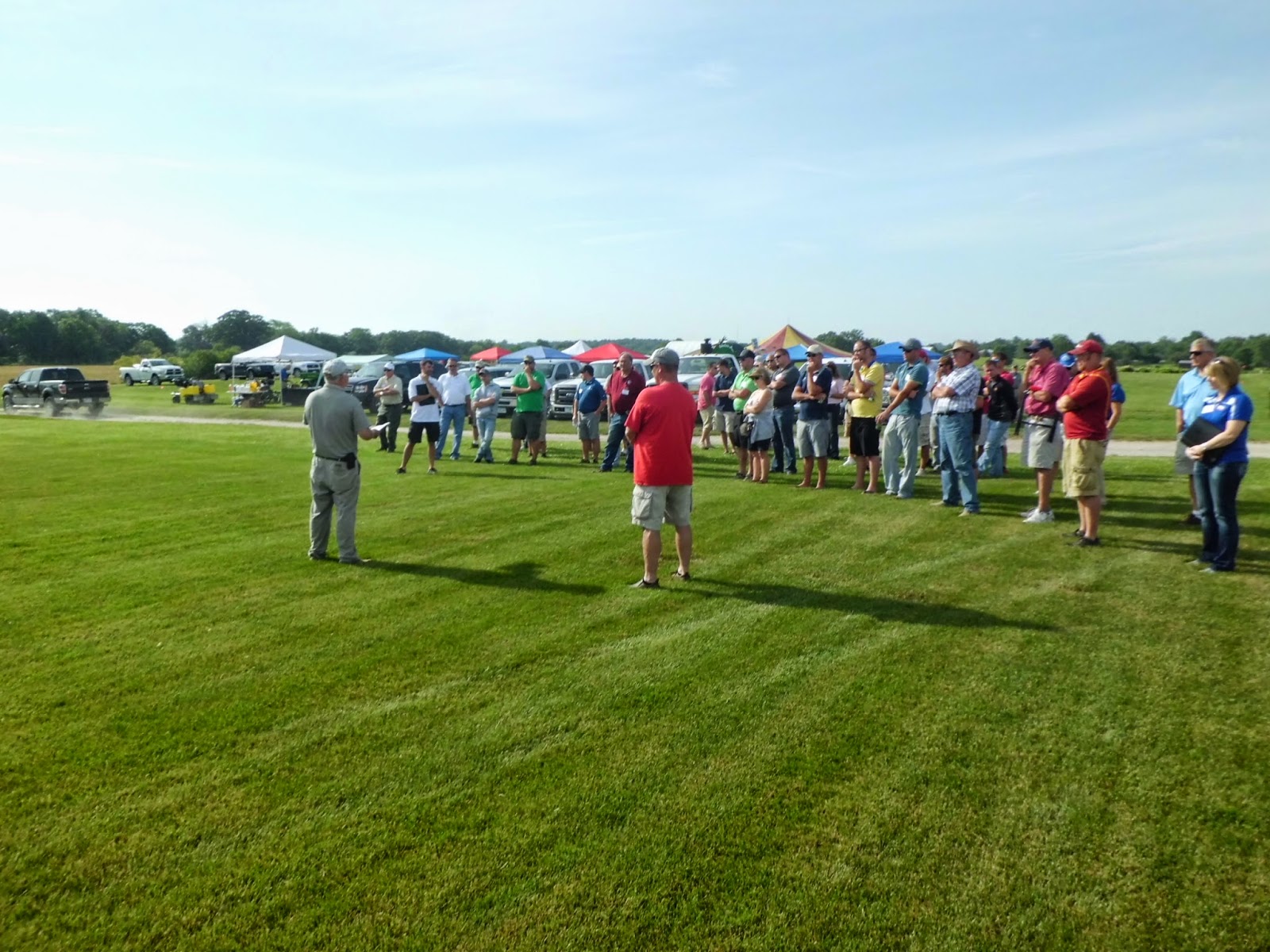
The annual turfgrass field day at the ISU horticulture research center went very well last. week.  We had perfect weather for it.  The weather is also perfect this week.  Here are a few pictures.  I have also posted the results from last years National Turfgrass Evaluation Trials (NTEP) that I mentioned I would post during my presentation.  Thanks to Larry Ginger for some of the pictures.


Here are the reports on last years NTEP data.  They originally appeared in the 2013 experiment station report, along with other reports from the turfgrass field area.  You can find the original report at:


Other NTEP reports from ISU and around the country can be found at ntep.org. 

Here are the reports on Kentucky bluegrass, perennial ryegrass, and tall fescue from 2013.


Tuesday, July 22, 2014

RUST DISEASE ON PERENNIAL RYEGRASS

Nick Christians
July 22, 2014
nchris@iastate.edu

On July 17, I received an e-mail from Larry Ginger of American Lawn Care with a picture of rust disease showing up on perennial ryegrass, but not on Kentucky bluegrass.  Rust is a fungal disease caused by fungi in the genus Puccinea.

Picture from Larry Ginger showing rust on ryegrass patch in lawn taken July 17.


I had not seen this problem at that time, but yesterday (July 21) I took data on the National Turfgrass Evaluation Program (NTEP) trial at the research station.  I found that many of the cultivars were covered with rust.  I took data on the rust problem this morning (July 22).  I have not seen the problem on the Kentucky bluegrasses as of today, but it clearly a severe outbreak on some of the perennial ryegrasses. Rust often shows up in August on Kentucky bluegrass, perennial ryegrass, and even on tall fesuce (see earlier blogs).  This year it is early and appears to be hitting the ryegrasses first.
 
 Close up of rust on Kentucky bluegrass from last year.


 Rust spores on my shoes after taking data.


 Three pictures of individual ryegrass plots covered with rust on July 22.


 Rust is clearly cultivar specific and there were cultivars covered with it and adjacent plots that were completely free of the disease.  This is another reason for choosing your grass seed carefully.  There is usually a good reason to spend a little more on grass seed.  I have not analyzed the data on which cultivars were affected, but that will be in next year's report.  NTEP does have data available on ryegrass susceptibility to this disease at ntep.org.

Rust is a fungi and there are fungicides that control it, but we generally recommend that you let the disease run its course.  It usually goes away by itself.  You may want to treat on sensitive areas, such as sports fields if it becomes necessary.  

These plots will be on the tour at the turfgrass field day this Thursday, July 24.


Friday, July 18, 2014

IOWA TURFGRASS FIELD DAY JULY 24

Nick Christians
July 18, 2014

The annual turfgrass research field day will be held at the Horticulture Research Station north of Ames, IA on July 24, Thursday of next week.  

We have a number of new things to show this year, including our work on nematodes in a sand-based golf course greens.

For more information, contact Jeff Wendel at the Iowa Turf Office at jeff@iowaturfgrass.org, phone 515-635-0306.  The web site is at http://www.iowaturfgrass.org/itihome.htm.  See the links below for registration and a map to the site.


July 24th - Iowa Turfgrass Field Day - Horticulture Research Station - Ames
Host: Dan Strey
8:00 Registration
8:45 Introductions - Registration Tent
9:00-11:00 Blue and White Tours (see tour schedule here)
10:00-11:00 Red Tour (required for Pesticide Applicator Training)
11:00 Turfgrass Insect, Weed & Disease ID Tour & Phytotoxicity Demo (required for PAT)
12:00 Lunch
Registration Deadline: July 17th. *Onsite Registration available for additional fee*
Registration Fee: $30.00 (includes Lunch)
Registration with Pesticide Applicators Training: $50.00 (includes Lunch)
Call 515-635-0306 with questions or to Register