Friday, October 26, 2012

HORT 451 ADVANCED TURF CLASS ON LINE SPRING 2013

Nick Christians
October 26, 2012

The advanced turf course, Hort 451 will be offered on line in the spring of 2013.  This is the first time that this course has been offered for off campus students.  It is available for undergraduate or minor graduate credit.  This is a two credit course, with two hours of lecture per week.


For a brief video on its content, go to:

http://www.ag.iastate.edu/video/v/Hort_451_XW_-_Professional_Turfgrass_Management

For more information on the Distance Education program at Iowa State and for instructions for registration, go to:

 http://www.agde.iastate.edu/course/?sem=s&year=2013


Hort. 351, the basic turf course, will also be available on line this spring.  This is a 3 credit course with 3 hours of lecture per week.

The cost for off campus students for either course, including those out of state or in other countries,  is:


Undergraduate credit - $277/credit
Graduate credit - $431/credit
Delivery fee - $162


If you have any questions, contact me:


Nick Christians, Ph.D.
University Professor
Iowa State University
Department of Horticulture
133 Horticulture Bldg.
Ames, IA 50011
515-294-0036

Thursday, October 25, 2012

CINCINNATI BENGALS STADIUM

Nick Christains
October 25, 2012

The American Society of Agronomy meetings were in Cincinnati this week and Zach Simons, one of our graduate students, set up a tour of the Paul Brown Stadium and practice facility with some of the other turf people from Tennessee and Georgia.  Darian Daly, the head sports turf manager gave us the tour.    It is a very impressive site.  The main field in the stadium  is artificial turf with rubber infill.  The practice fields were bermudagrass that had been overseeded recently with perennial ryegrass.  Thanks to Darian for a great tour.  Hopefully we can get an ISU intern there at some time in the future.


Darian Daly is on the right with the black jacket and cap.  Zach Simons is in the green shirt.


This is the practice fields next to the stadium.  The bermuda is still not completely dormant and the overseeded ryegrass is just beginning to emerge.


Monday, October 15, 2012

MYSTERY PROBLEM ON BLUEGRASS GROW-IN

Nick Christians
October 15, 2012
nchris@iastate.edu

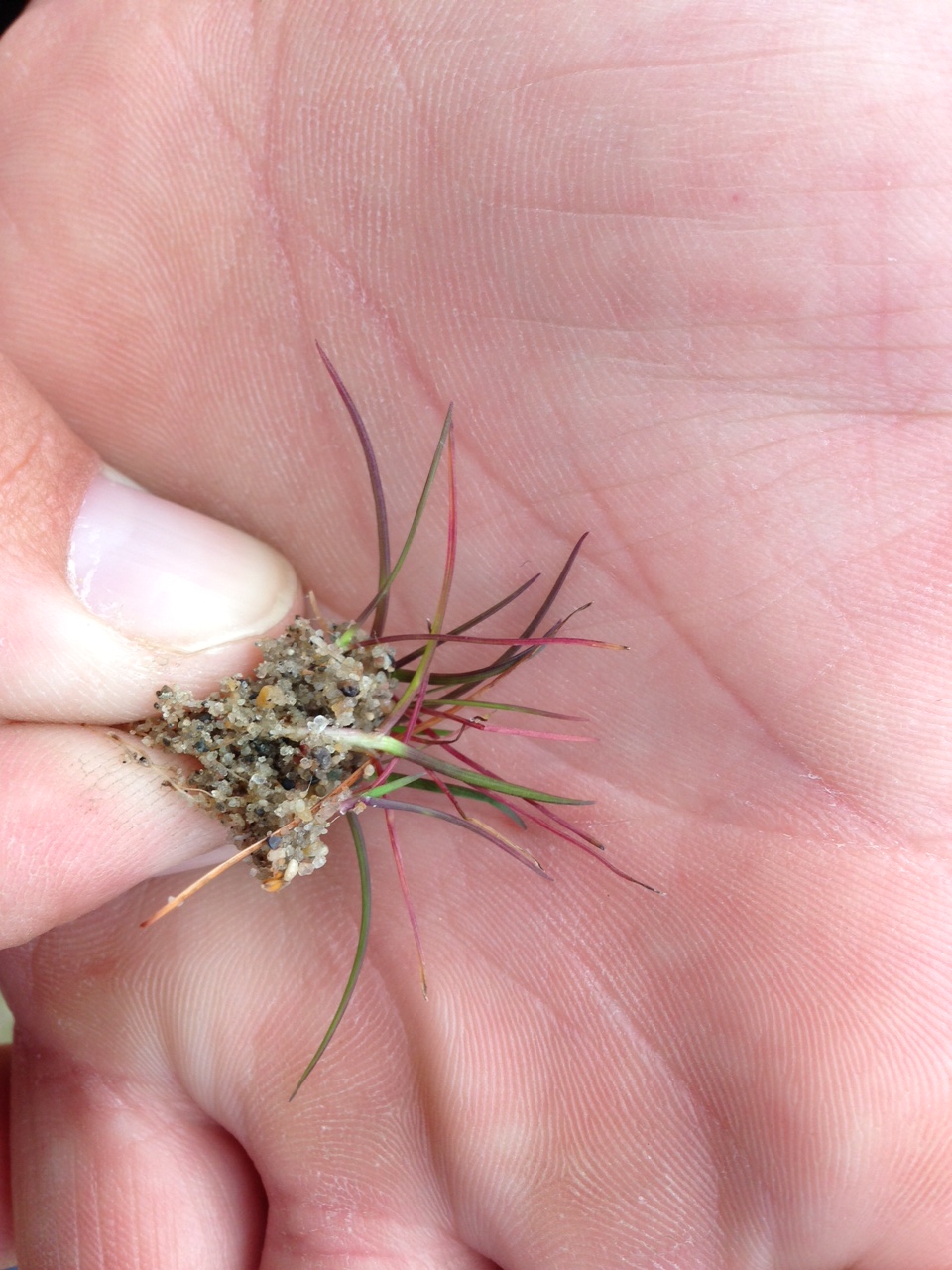
Here is a mystery problem from two of our sports turf students, Joel Rieker and Kevin Hansen.  It is from a new Kentucky bluegrass grow-in on one of the new sand-based sports fields on campus.  It is showing up as patches from one to two feet in diameter.  Notice the close up of the turf in the third picture, showing a redish to purple discoloration on new growth.

I am suspecting a nutritional problem.  My guess is phosphorus and I am recommending a application of phosphorus as soon as possible.  I think that there is probably some fungal organism involved but I suspect that it is because the grass is deficient in phosphorus.  We may also try some chlorothalonil fungicide on a test area.  They will also do a soil test on the area and take a sample of the grass to the plant disease lab, but both will take some time.  It is the end of the season and we do need to act fast.

I could be wrong and I would like some feedback on this.  Has anyone seen this before on a bluegrass grow-in on sand?  If so what did you do about it.  Send the response to my e-mail, or put it on the comment section below.  Any ideas would be helpful.


Wednesday, October 10, 2012

BERMUDAGRASS CONTROL

Nick Christians
October 10, 2010


Since I posted the information on the amount of Bermudagrass showing up in Iowa, I have had a number of questions on how to kill it.  Roundup is the standard answer, but it is very hard to kill.  I have also heard from former students in Bermudagrass country about its control.  Below are two recommendations.  Notice that these come from other states and that pesticide labeling and recommendations vary by state.  Check labels for use of these products in your locations.


The first is as follows:


In our region, we use a combination of  Roundup and Turflon (Triclopyr) Ester. 
Tank mix Roundup is 3oz/1000ft2 and Turflon at 2oz/1000ft2.  Be careful with seeding cool-season grasses back into the area.  If seeded within 3 days, you'll see about 50-75% germantion on the cool-season seed.  If you wait 2 weeks, you'll see anywhere from 75-100% germination. 


(You can also find a number of articles on the internet about using Turflon Ester to control Bermudagrass.)

The second from another location includes Roundup and Fusilade in a tank mix, followed by Tupersan.

The aggressive way of killing Bermudagrass is to apply Roundup at 4 oz/1000 ft2  with Fusilade at 2 oz/1000 ft2 in a tank mix combination.  It may take a repeat application

You can then use Tupersan at 14-16 oz /1000 ft2 as a follow up.  Tupersan will hold back the Bermuda and you can seed into it. 

Again, check label recommendations for your area before using these approaches.


Thursday, October 4, 2012

NEW NTEP TALL FESUE TRIAL AT IOWA STATE

Nick Christians
Oct. 4, 2012


 One of our major projects at the research station this fall is the national turfgrass evaluation (NTEP) tall fescue cultivar evaluation project.  It includes 116 cultivars with most of the  newest turf-types.  The project was seeded on Sept 20.  We had a lot of help from the ISU turf club.  We have irrigation on the site and conditions have been perfect for germination.  I have included pdf files of the cultivar list and the plot plan.  If anyone would like to stop in and see the trial, feel free to come anytime 8 to 4 Monday through Friday.


Figure 1.  Turf club members watering the newly seeded trial on Sept. 20


Figures 2 and 3.  The trial on Oct. 3, 2012.


The plot plan.
 The cultivar list.

Tuesday, October 2, 2012

GRAY LEAF SPOT IN CENTRAL IOWA

Nick Christians
October 2, 2012

On September 4, I put up a post warning that Gray Leaf Spot might show up in Iowa because of the unusually warm conditions around labor day.

On the 4th I wrote the following:

"This disease is caused by the fungi Pyricularia grisea. It seems to selectively hit perennial ryegrass on intensely managed areas such as golf course fairways and sports fields. Under the right conditions, it can be more devastating than Pythium blight. When it hits, it can wipe out large areas of turf overnight.  Fungicides, such as Banner/Daconil will control it, but they must be applied before the outbreak.  Once the disease begins, it is too late to apply.  The reason I bring this up is that we are in the same weather pattern again this year.  The disease does not always occur when its hot around Labor Day, but it did last year and I would watch for it this year".

What I didn't know at the time was that it would be me that would get hit with the gray leaf spot.  When I went out to take data on the perennial ryegrass trial at the research station in mid September I found that the ryegrasses in the trial appeared to have collapsed.  They looked terrible.  I then looked at two other areas of perennial ryegrass on the site and saw that it looked the same.  Andrew Hoiberg, who recently graduated with his Ph.D. was at the station at the time and commented that it looked like gray leaf spot.  On closer inspection, that is what it appears to be.  It was right on time, shortly after Labor Day during an unusually warm spell.

This trial is part of the national turfgrass evaluation trials (NTEP) and we purposefully do not treat it with fungicides.  The damaged cultivars are beginning to show some recovery as of the beginning of October, but they are still showing signs of the damage.  Under normal conditions, we would simply reseed into the ryegrass and we would have it back in a couple of weeks.  We are unable to do that here because of all the different varieties that are involved.  We will have to wait for recovery.

By the way, is it Gray Leaf Spot or Grey Leaf spot?  You will see many examples of each if you search the internet.  I'm using Houston Couch's book as my source and going with Gray.

The pictures below are of the site in mid September when the damage was most severe.  The first three are of the NTEP perennial ryegrass trial.  The last four are closeups of the damage.