Nick Christians
August 20, 2013
nchris@iastate.edu
Hort 351 XW Turfgrass Establishment and Management is available on line this fall. It begins next week. This is a totally web based course and can be taken from anywhere in the world that there is internet connection.
Check out the details at:
http://agonline.iastate.edu/courses/f2013hort-351-xw

Tuesday, August 20, 2013

Friday, August 9, 2013
PROSO MILLET FOUND IN LAWN
Nick Christians
August 9, 2013
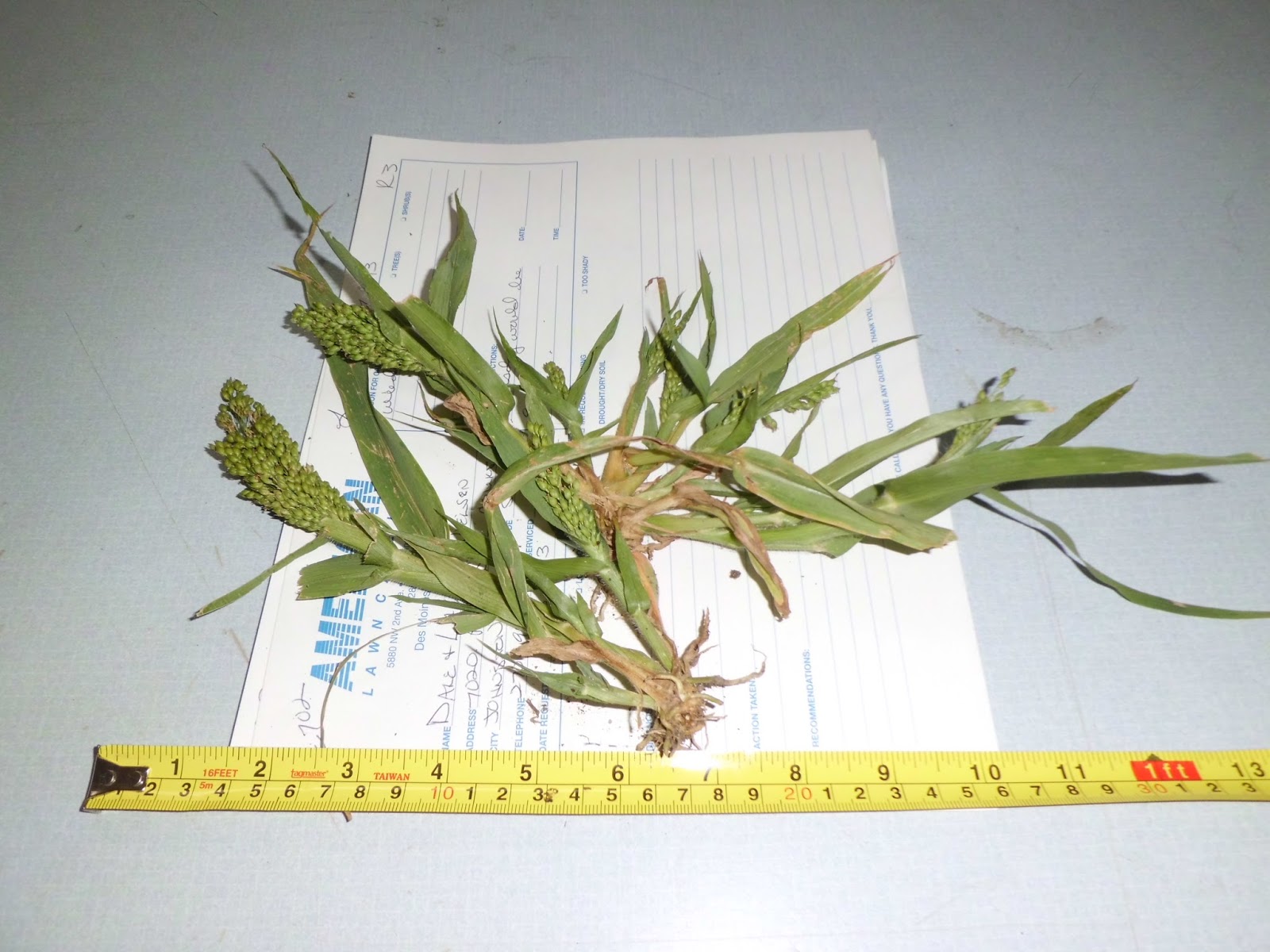
Here is an interesting weed problem that I have not run into before. The pictures come from Larry Ginger of American Lawn Care. Larry found it growing in a lawn in Ankeny, IA.
I did not know what it was, so I sent it to our weed guy in Agronomy, Dr. Bob Hartzler. Bob identified it as Proso Millet. Further investigation on the internet indicates that this is exactly what it is.
Proso Millet (Panicum miliaceum) is a warm season, annual grass that has been used as a crop in areas to the west of us for many years. It is a great seed producer and the seed can be used as feed for a variety of animals. Birds also like it, which would explain its presence in a lawn.
Thanks, Larry. Keep them coming. This is a good learning experience for me.


August 9, 2013
Here is an interesting weed problem that I have not run into before. The pictures come from Larry Ginger of American Lawn Care. Larry found it growing in a lawn in Ankeny, IA.
I did not know what it was, so I sent it to our weed guy in Agronomy, Dr. Bob Hartzler. Bob identified it as Proso Millet. Further investigation on the internet indicates that this is exactly what it is.
Proso Millet (Panicum miliaceum) is a warm season, annual grass that has been used as a crop in areas to the west of us for many years. It is a great seed producer and the seed can be used as feed for a variety of animals. Birds also like it, which would explain its presence in a lawn.
Thanks, Larry. Keep them coming. This is a good learning experience for me.

Wednesday, August 7, 2013
CUTWORMS ON GREENS
Nick Christians
August 7, 2013
It's that time of year again when the black cutworm (Agrotis ipsilon) larvae begin to show up on bentgrass greens and fairways. For us at the research station, it is normally about field day time that they become a problem. They were right on time this year.
They are a little hard to see, but there are about 50 birds on bentgrass area below at the research station. Birds feed on the larvae and are a good sign that there is a problem.
They are surface feeders and they can easily be controlled with most common insecticides. We used Sevin (Carbaryl). It was very effective.

A close look at the surface will reveal a lot of feeding holes. They are often empty because of the feeding of birds

There will also likely be some larvae on the surface, like the one below sighted on August one at the research station.
This is a picture of the adult. This is from the Purdue web site. Notice the dagger shaped black mark on each wing.

August 7, 2013
It's that time of year again when the black cutworm (Agrotis ipsilon) larvae begin to show up on bentgrass greens and fairways. For us at the research station, it is normally about field day time that they become a problem. They were right on time this year.
They are a little hard to see, but there are about 50 birds on bentgrass area below at the research station. Birds feed on the larvae and are a good sign that there is a problem.
They are surface feeders and they can easily be controlled with most common insecticides. We used Sevin (Carbaryl). It was very effective.

A close look at the surface will reveal a lot of feeding holes. They are often empty because of the feeding of birds

There will also likely be some larvae on the surface, like the one below sighted on August one at the research station.

This is a picture of the adult. This is from the Purdue web site. Notice the dagger shaped black mark on each wing.

Armyworms can also be a problem at this time of year, but this year it was black cutworm at the research station.
Monday, August 5, 2013
MORE BERMUDAGRASS IN THE UPPER MIDWEST
Nick Christians
August 5, 2013
nchris@iastate.edu
In the last few weeks, I have published several blogs on the recent invasion of bermudagrass into the Iowa and Nebraska region. See July 29 for information on identification and June 24 for information on control.
The two pictures below are from Rob Elder of Omaha Organics out of Nebraska. These are very long bermudagrass stolons, longer than anything that I have seen in Iowa. If anyone has observed bermuda north of the Ames/Des Moines area, let me know. I am interested in how far north if is occurring.


August 5, 2013
nchris@iastate.edu
In the last few weeks, I have published several blogs on the recent invasion of bermudagrass into the Iowa and Nebraska region. See July 29 for information on identification and June 24 for information on control.
The two pictures below are from Rob Elder of Omaha Organics out of Nebraska. These are very long bermudagrass stolons, longer than anything that I have seen in Iowa. If anyone has observed bermuda north of the Ames/Des Moines area, let me know. I am interested in how far north if is occurring.


Friday, August 2, 2013
THANK YOU FOR FERTILIZER DONATION
Nick Christians
August 2, 2013
Thank you to Damian Richardson (pictured below) and the others from John Deere Landscapes #249 in Clive, Ia for donating 2000 lbs of fertilizer for use by the ISU turf club. Damian brought the fertilizer to the annual field day at the research station yesterday, August 1. The field day went very well. We had perfect weather for the event and attendance was good. Thanks to everyone who was there.
Damian can be reached at
The group at branch 249 are as follows: Thanks again to the whole crew.


August 2, 2013
Thank you to Damian Richardson (pictured below) and the others from John Deere Landscapes #249 in Clive, Ia for donating 2000 lbs of fertilizer for use by the ISU turf club. Damian brought the fertilizer to the annual field day at the research station yesterday, August 1. The field day went very well. We had perfect weather for the event and attendance was good. Thanks to everyone who was there.
Damian can be reached at
Damian Richardson
John Deere Landscapes, CSSR I
9289 Swanson Blvd, #4 Clive, IA 50325
(W) 515-222-5344
(F) 515-222-5345
The group at branch 249 are as follows: Thanks again to the whole crew.
·
John Matthies –
Branch Manager
·
Damian Richardson –
Customer Sales and Service Rep
·
Jay Goughnour –
Customer Sales and Service Rep
·
Steve Lindner –
Outside Sales Rep


Wednesday, July 31, 2013
IOWA STATE TURF FIELD DAY IS TOMORROW, AUGUST ONE
Nick Christians
July 31, 2013
Here is a news release from Iowa State on tomorrow's field day.

Editor's note: This release, sent
Wednesday, left out the field day's starting time. It is 8 a.m.
7/24/13
Contacts:
Nick Christians, Horticulture, (515) 294-0036, nchris@iastate.edu
Ed Adcock, Agriculture and Life Sciences Communications Service, (515) 294-2314, edadcock@iastate.edu
Aug. 1 Field Day Brings Turfgrass Specialists to Iowa State University Research Station
AMES, Iowa — Turfgrass specialists who work with golf courses, athletic fields and lawn care services will meet at 8 a.m. Aug. 1 for an annual field day at the Iowa State University Horticulture Research Station.
Faculty and staff from Iowa State departments of horticulture, agronomy, entomology and natural resource ecology and management will present informational sessions along with speakers from the Iowa Department of Agriculture and Land Stewardship and Indian Hills Community College. Topics include pond management, pesticide application, weed management and turfgrass insect, weed and disease identification.
The field day includes a Pesticide Applicator Training session to meet requirements for applying pesticides. Suppliers of turfgrass products will exhibit at the field day.
Registration information is available at www.iowaturfgrass.org. The Horticulture Research Station is located at 55519 170th St., Ames, which is three miles north of Ames on Highway 69, and east on 170th Street about 1.5 miles.
Iowa State sponsors the field day with the Iowa Turfgrass Institute, the Iowa Golf Course Superintendents Association, Iowa Sports Turf Managers Association and the Iowa Professional Lawn Care Association.
##
On the Web: This and all other Iowa State University College of Agriculture and Life Sciences news releases and related photos are available at http://www.cals.iastate.edu/news/
July 31, 2013
Here is a news release from Iowa State on tomorrow's field day.

Iowa
State University
College
of Agriculture and Life Sciences
7/24/13
Contacts:
Nick Christians, Horticulture, (515) 294-0036, nchris@iastate.edu
Ed Adcock, Agriculture and Life Sciences Communications Service, (515) 294-2314, edadcock@iastate.edu
Aug. 1 Field Day Brings Turfgrass Specialists to Iowa State University Research Station
AMES, Iowa — Turfgrass specialists who work with golf courses, athletic fields and lawn care services will meet at 8 a.m. Aug. 1 for an annual field day at the Iowa State University Horticulture Research Station.
Faculty and staff from Iowa State departments of horticulture, agronomy, entomology and natural resource ecology and management will present informational sessions along with speakers from the Iowa Department of Agriculture and Land Stewardship and Indian Hills Community College. Topics include pond management, pesticide application, weed management and turfgrass insect, weed and disease identification.
The field day includes a Pesticide Applicator Training session to meet requirements for applying pesticides. Suppliers of turfgrass products will exhibit at the field day.
Registration information is available at www.iowaturfgrass.org. The Horticulture Research Station is located at 55519 170th St., Ames, which is three miles north of Ames on Highway 69, and east on 170th Street about 1.5 miles.
Iowa State sponsors the field day with the Iowa Turfgrass Institute, the Iowa Golf Course Superintendents Association, Iowa Sports Turf Managers Association and the Iowa Professional Lawn Care Association.
##
On the Web: This and all other Iowa State University College of Agriculture and Life Sciences news releases and related photos are available at http://www.cals.iastate.edu/news/
Monday, July 29, 2013
BERMUDAGRASS IS SPREADING NORTH
Nick Christians
July 29, 2013
I received the first picture from Rob Elder of Omaha Organics. It is a stolon of bermudagrass Cynodon dactylon. As is the case in central Iowa, this is unusual for the Omaha area. Not long ago, you would not have found this species in that area because it would die each winter due to the cold weather. It is now surviving the winter.

How can you tell it is bermudagrass? While the long stolon is a pretty good clue, there are other species with stolons, so you have to look close at its characteristics. The first clue is vernation, as pictured below. Vernation is the way in which new blades emerge from the sheath. Bermuda is folded like the grass on the left, while Zoysiagrass is rolled like the grass on the right. Creeping bentgrass can also form a stolon like the one above.

Bermudagrass and Zoysia have a hairy ligule like the one on the right in the picture below, whereas bentgrass has a membranous ligule like the one on the left.

Here are two actual pictures of the hairy ligule of bermudagrass. If the grass that you are trying to identify has a membranous ligule, it will likely be a cool-season grass. If it is a warm-season grass like bermuda or zoysia, it will have a ligule that is a fringe of hairs.


July 29, 2013
I received the first picture from Rob Elder of Omaha Organics. It is a stolon of bermudagrass Cynodon dactylon. As is the case in central Iowa, this is unusual for the Omaha area. Not long ago, you would not have found this species in that area because it would die each winter due to the cold weather. It is now surviving the winter.

How can you tell it is bermudagrass? While the long stolon is a pretty good clue, there are other species with stolons, so you have to look close at its characteristics. The first clue is vernation, as pictured below. Vernation is the way in which new blades emerge from the sheath. Bermuda is folded like the grass on the left, while Zoysiagrass is rolled like the grass on the right. Creeping bentgrass can also form a stolon like the one above.

Bermudagrass and Zoysia have a hairy ligule like the one on the right in the picture below, whereas bentgrass has a membranous ligule like the one on the left.

Here are two actual pictures of the hairy ligule of bermudagrass. If the grass that you are trying to identify has a membranous ligule, it will likely be a cool-season grass. If it is a warm-season grass like bermuda or zoysia, it will have a ligule that is a fringe of hairs.


Subscribe to:
Posts (Atom)