Wednesday, June 2, 2010

HORTICULTURE FIELD DAY-JULY 29

The ISU Horticulture Field Day will be Thursday July 29 at the Horticulture research station. For registration information, see http://www.hort.iastate.edu/news/.

Field Day presentations

  1. Wine Lab. The Midwest Grape and Wine Industry Institute will discuss wine grape harvest parameters and their importance to winemaking. The measurements of pH, Titratable Acidity, and Brix will be demonstrated.
  2. Computer Applications in Horticulture
  3. This will be a hands-on session covering the latest in software development for the landscape industry. There will be a presentation that will include traditional computer applications as well as iPhone/iPod Touch/iPad applications.

  4. High Tunnels. High tunnels extend the growing season and produce greater yields of high quality fruits and vegetables. You will get the chance to see both fruits and vegetables growing in different sized high tunnels.
  5. Crabapples. Since 1985, the Iowa State University Department of Horticulture has participated in the National Crabapple Evaluation Program, and during this tour stop we will feature some of the best crabapples for the Iowa landscape. Join us as we traverse this impressive collection in search of that perfect crabapple.
  6. Chainsaw safety. You will be learning the strategies to keep yourself and others safe when working with chainsaws.
  7. Vineyard. Field day attendees will tour research vineyards that include wine grape cultivars, cropping and canopy management studies, and weed control and soil quality management projects. Iowa State University faculty and graduate students will provide tours and answer viticultural questions.
  8. Orchard (3 presentations)
  9. Rootstock/Cropping levels study
    This orchard study on 'Gibson Golden Delicious' apple evaluates the performance of five dwarfing apple rootstocks subjected to under different cropping levels. Treatments are being monitored for differences in fruit growth rate, maturity, yield, fruit size and quality, and the ability to produce blossoms for next season's crop.

    Airblast Spraying
    Airblast sprayers offer an effective and economical means for applying fungicides, insecticides, growth regulators and foliar nutrients in orchards and vineyards. Compared to conventional sprayers, airblast systems allow growers to concentrate spray where less liquid is applied per acre, and at higher concentrations, less pesticide is needed to attain effective coverage. Dr. Domoto will be explaining how this is accomplished, and an airblast sprayer will be demonstrated.

    Disease monitoring in Apples
    This study is evaluating remotely estimated weather as a warning system for sooty blotch and fly speck on apples.

  10. Aquatic Research Facility
    The discussion will focus on current research on fish production with an emphasis on this year's Bluegill project.

  11. Vegetables (2 presentations)

    This research looks at the impact of row covers on disease and insect suppression on
    muskmelons and butternut squash.

    As part of a multi-state project, we are looking at "flora provisioning" as a way to increase pollination of muskmelon and squash. A strip of perennial flowers are planted to attract pollinators to the plot.


  12. EarthKind Rose Trial. EarthKind is an innovative new program that addresses environmental landscape management. We will discuss the northern EarthKind rose trial planted at the Horticulture Research Farm as well as the newly established EarthKind Hydrangea trial. These two plantings are part of the nationwide trialing program of rose and hydrangea cultivars being evaluated for their suitability for inclusion in EarthKind landscapes

  13. The student organic farm ...

  14. Turf Demonstrations
    • Lawn mower safety, maintenance, and selection.
    • A walking tour to identify weeds, insects, diseases, and their control.
    • Turf research plot tour.

Tuesday, June 1, 2010

Golf Course Management in Italy

I recently took a student group to Italy for a study abroad trip. Here is a picture of San Domenico Golf Course in far southern Italy in the province of Puglia (the heel of the boot). The club president came out to talk with us and the first thing he said was that their biggest problem is Poa annua. He wanted to know if there was anything new from the United States that would get rid of it.

It is interesting that there seems to be the same problems wherever you go.

Wednesday, May 26, 2010

Research Update: Velocity Herbicide

Velocity is a postemergence herbicide from Valent Professional Products that is labeled for selective postemergence control of annual bluegrass and rough bluegrass in fairway height creeping bentgrass and perennial ryegrass. Velocity also controls certain broadleaf weeds and provides suppression of dollar spot in creeping bentgrass.


The product label describes three different protocols for converting turf areas: a slow, rapid, or transitional conversion program. The slow and transitional conversion programs are recommended for areas of turf heavily infested with annual bluegrass/rough bluegrass and utilize lower application rates. The rapid conversion program is recommended for areas of turf with light or moderate infestations of annual bluegrass/rough bluegrass and utilizes higher application rates.

I had some Velocity plots setup at Hyperion Field Club this past summer that yielded very positive results. The plots were located on a practice putting green heavily infested with annual bluegrass. I made four applications of Velocity on 14-day intervals starting the beginning of June and concluding the middle of July at 2 oz/A. A fifth and final applications was made on October 1 at the same rate. This spray regime closely follows the protocol of the transitional conversion program.

Velocity does tend to yellow the turf even after one application. The color differences are even more noticeable in this study because of the untreated plots being directly adjacent to the treated plots. Velocity can be tank mixed with a chelated iron product to lessen the discoloration.


Late in the fall just before winter arrived, the plots that had received the Velocity applications were noticeably lighter green in color compared with the other plots. This could have indicated the beginning of the transition from a mixed stand of annual bluegrass/creeping bentgrass to solid stand of creeping bentgrass.


Early in the spring as the plots began to green-up the differences in the amount of annual bluegrass between the treatments were striking. The majority of annual bluegrass had been removed from the plots treated with Velocity. Based upon visual inspection, the control plots had approximately 60% annual bluegrass. We estimated the coverage of annual bluegrass in the plots receiving Velocity had been reduced to around 20%.


This study is entering its second year and will be conducted again this year to see if the results can be duplicated. More information about Velocity herbicide, including product research and additional literature, can be found by visiting the Valent website.

Marcus Jones
Graduate Research Assistant

Thursday, May 20, 2010

Plant Growth Regulator Effects on Seedhead Control and Early Season Dollar Spot, Tim Sibicky CDGA

We are testing a variety of plant growth regulator products and fungicide chemistries for efficacy on early spring seedhead control and possible disease reduction. This study is being conducted on a fairway mixed stand (50/50) of Poa annua and creeping bentgrass and has been initiated to show visual turf quality differentiation of the various products. Last season, test strips on a nursery green at North Shore Country Club in Glenview, IL showed considerably less disease when a plant growth regulator, Embark, was applied once during June. The early season applications as seen in the bar graph below for “Visual Quality” are at 21 and 28 days after treatments (DAT).

The first application was critically timed to coincide with forsythia bloom on April 14th. There are three Embark treatments all at the 40 oz/acre rate; Embark alone, Embark with Primo 0.125 fl oz/M and Embark with Primo 0.125 fl oz/M and also Signature 4 oz/M. This series of Embark treatments was only administered as a one time application due to a high amount of tip burn on the creeping bentgrass and chlorosis on the Poa annua. All treatments were within labeled rates. The result is poor visual quality of turf in this early spring period. However, all of the Embark treatments were excellent at eliminating all Poa annua seedheads (100% control).


Two combinations of Proxy and Primo (5 fl oz/M + 0.125/M) were tested, at a 21 day interval with one including Signature at the 4 oz/M rate. However, neither of the two mixes resulted in greater seedhead suppression than any Embark combination (see graph). The visual quality for the Proxy + Primo + Signature yielded better quality at both the 21DAT and 28DAT (7 days after second application), but interestingly, there was no statistical differences between the treatment that contained only Proxy + Primo and any of the Embark treatments.


So, the question that is brought to my attention from the data is whether there is some sort of synergistic effects in mixing Proxy + Primo + Signature? On the flipside, we don’t see any of these effects in tank mixing with Embark, so this means we can rule out that it may have had something to do with a pigmented spray or not. Secondly, will the sacrifice in early season turf quality using Embark pay off when we get to the heat of the summer? And lastly, is it worth the dollars to apply fungicide this early for dollar spot when we have very low disease pressure? Over the next few weeks, we will likely begin to start seeing dollar spot and I will be excited to see how these early season applications of plant growth regulators and fungicides function in producing good turf quality and resistance to disease.

Tim Sibicky
TSibicky@hotmail.com
Chicago District Golf Association
11855 Archer Avenue
Lemont, IL 60439

Wednesday, May 12, 2010

Rain, Divots, and a Car Parked on a Green


Rainy conditions across much of the state have limited everyone’s outdoors activity thus far this week. So far, Ames has received over 1.5 inches of rain and it looks like we’re headed for more on Wednesday. With the extra time spent in the office this week, I had the opportunity to put together a write up about some of my research involving the stolon growth of various creeping bentgrass cultivars and their ability to recover from divots.

A host of improved cultivars of creeping bentgrass have been released onto the market that possess improved agronomic characteristics such as vertical shoot growth, higher shoot densities, and narrower leaf blades. While many believe these morphological characteristics create an improved playing surface there are questions about the ability of these improved varieties to spread laterally compared to older varieties such as Penncross. While it is generally agreed that creeping bentgrass possesses relatively high recuperative potential, minimal research has focused on differences among cultivars of creeping bentgrass.

The objectives of this research were to determine differences in lateral spread and divot recovery of 24 cultivars of creeping bentgrass in mowed and non-mowed settings. The results of this research would help turf managers select cultivars of creeping bentgrass to match specific site requirements.

I started the study June 1 by transplanting 100 plugs of creeping bentgrass (24 different cultivars) into a fallow area. Prior to transplant, the area was treated with Basamid in order to limit competition from weeds. The plugs were simply allowed to grow, unabated, throughout the season.


The second phase of the study involved creating simulated divots by removing a core of turf and soil from a fairway that contained the same 24 cultivars with a cup cutter and backfilling the area with soil. No seed was added. The “divots” were simply allowed to grow and heal back in. The maintenance of the area was designed to simulate golf course fairway conditions.

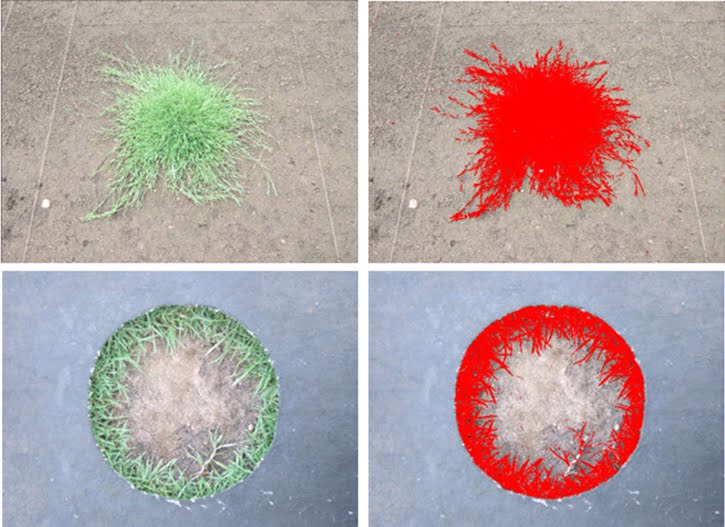
I used a new piece of technology to evaluate the progress of the study called Digital Image Analysis. The software is able to distinguish between different colors (green turf and bare soil in this case) and calculates the percentage of green turf in the picture. With some simple calibrations and calculations, I am able to determine the rate of spread of each of the cultivars.


What we found


Stolon Growth – Non mowed. Differences among cultivars were observed for lateral spread. Penncross had the fastest establishment rate and Bengal had the slowest. The cultivars SR 1150, Crenshaw, Imperial, Kingpin, L-93, MacKenzie, Crystal Bluelinks, Pennlinks II, Penn G-6, Putter, Memorial, Penn A-4, and Tyee all had establishment rates statistically similar to Penncross. The others had growth rates slower than Penncross.


Divot Recovery - Mowed.
Differences among cultivars were observed for divot recovery rate. Imperial had the fastest recovery rate and Alpha the slowest (Table 1). The cultivars Penn G-6, Alister, SR 1150, Crystal Bluelinks, Southshore, Penncross, L-93, and Century all had divot recovery rates statistically similar to Imperial.


While the differences appear small, consider that divots can take anywhere between 6 and 10 weeks to heal depending on the time of year and the management conditions. A small difference each day could end up being a big difference over the course of a couple months.

One of the big factors influencing lateral spread of grasses with stolons is the length of the internodes. As I stated earlier, the improved cultivars of creeping bentgrass posses higher shoot densities. This is possible because these cultivars have shorter internodes, thus a higher number of shoots per area.

I measured the internode length of all 24 cultivars and the general trend is that grasses with longer internodes (lower shoot densities) spread faster than grasses with shorter internodes (higher shoot densities). The take home message, there is a trade-off between lateral spread and shoot density. The location of the area (green, tee, fairway) should partially dictate cultivar selection given that cultivars of creeping bentgrass vary in their lateral spread.

On a side note, did anybody see the story from the TPC at Sawgrass last week about the couple who drove and parked their car on the 8th green? I first saw the story on the Golf Course Management Blog. If you haven’t seen it, it’s worth the read.

Marcus Jones
Graduate Research Assistant

Sunday, May 9, 2010

Springtime Grub Issues

I was wondering if anyone else out there is experiencing grub problems this spring. We have had some digging for about 2 weeks now. We examined the turf to find numerous grubs like you would in the fall. I suspect that the amount of grubs might be attributed to the Japanese beetles that we experienced in mass numbers last year for the first time. I would be interested to hear from anyone that is or has experienced this problem before.

PS caught my first coon last night…..

Randy Moeller
Golf Course Supervisor
City of Muscatine, Iowa 52761

Thursday, May 6, 2010

My Take on the "Dandelion King"

I urge you to read Marcus’ blog posting from Wednesday, April 28th. The post refers to an article from the NY Times and a person self dubbed the ‘Dandelion King.’ I find his statement that the war on weeds isn’t “winnable at a morally acceptable cost” is based on his opinion rather than any actual knowledge of turfgrasses or turfgrass management. See the complete article by clicking here.

I believe everyone in our industry should heed Marcus’ advice, “Equip yourself with this knowledge so you can provide an insightful answer next time you are challenged about the benefits of turfgrass.” The Wednesday April 28th blog article from Marcus contains excellent ‘equipment’ for that answer.

Again and again I observe the most ‘interesting’ writers getting their blather printed as fact because they are able to editorialize with word choices and interesting adjectives. For example, the so called ‘Dandelion King’ states; “I soon learned that the carpets of green in suburbia are the product of assiduously applied chemicals…” The word assiduous sounds very sinister here but the definition is benign:


I am certain the author meant ‘constant in application’ but the truth we know is that diligent is a better definition.

What the author obviously does not understand is that good management can lead to good turfgrass quality without an abundance of inputs. He just ‘doesn’t have time to figure this stuff out,’ so he has developed an ‘environmental excuse’ for his poor skills. Take a look at Marcus’ scientific response and help this author and others like him realize that there is nothing insidious about proper turfgrass management. It does take a little work and knowledge, but the environment will benefit from that knowledge and effort.

I won’t go on bashing this author about the other misrepresentations in his article, except to say that his ‘multiple’ applications of pre emergent are senseless and the subsequent post emergent applications he so despises have little to do with the success or failure of the preemerge. So it goes.

Suffice it to say the author has done just enough ‘Googling’ to be dangerously misinformed. Atrazine is a grass killer, let’s not lump it in as a ‘lawn chemical.’ Please.

Bottom line is simple, we either educate those that think like the ‘Dandelion King’ or we let the self proclaimed ‘environmentalists’ screw up things beyond belief.

Jeff Wendel
Executive Director
Iowa Turfgrass Institute